
★ INCLUDED TODAY: The New Live Pocket Masterclass — live with Don, September 10 at 11:00 AM Eastern ★
Lock In My Pocket Trades For LIFE!
For just $1.91 a trade over the next 10 years.
Based on about one Pocket trade a week — roughly 520 trades over ten years.

“Let me just send you the trade. You place it in about a minute, then go live your life.”
— Don Kaufman, Co-Founder & Chief Market Strategist, TheoTrade
I find the setup, I build the Pocket, and it lands on your phone. The company, what to buy, what to pay, your floor, your ceiling.
Enroll now so you don’t miss my next upcoming alert.
Lifetime Pocket Profits Alerts is open. $995 one time, no renewals ever. The Concierge goes to the first 50 people who join, and enrollment closes September 10th.
Enrollment closes in
Here’s What You Saw Today.
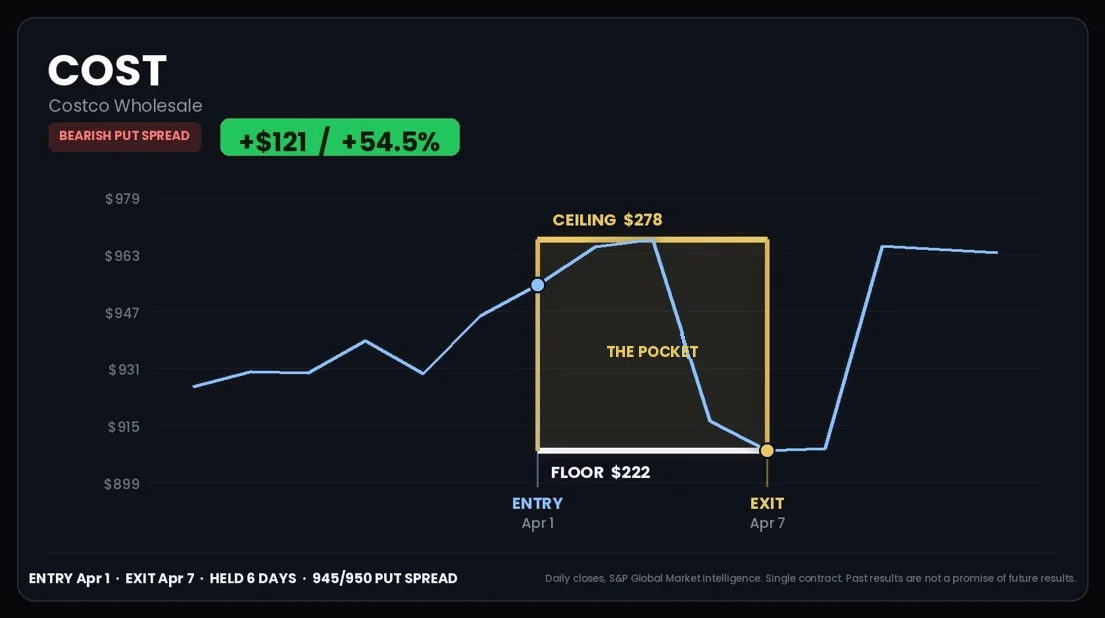
You watched me put $222 into Costco and take $121 out of it six days later. A 54% gain.
That’s the target on every trade I take. 30% or better, in 30 days or less. Costco came in at 54% in six days.
I had no opinion about Costco. Couldn’t have told you whether it was a good company that week. It went against me for the first two days and it didn’t matter.
Because I already knew the worst that could happen before I clicked buy. I set it myself. $222. That was the floor, and the trade could not fall through it.
And I knew the most it could make. That was the ceiling.
Floor underneath. Ceiling on top. The trade lives in the space between them. That space is The Pocket.
Iran, the Fed, whether AI is a bubble — none of it changed my floor by a dollar.
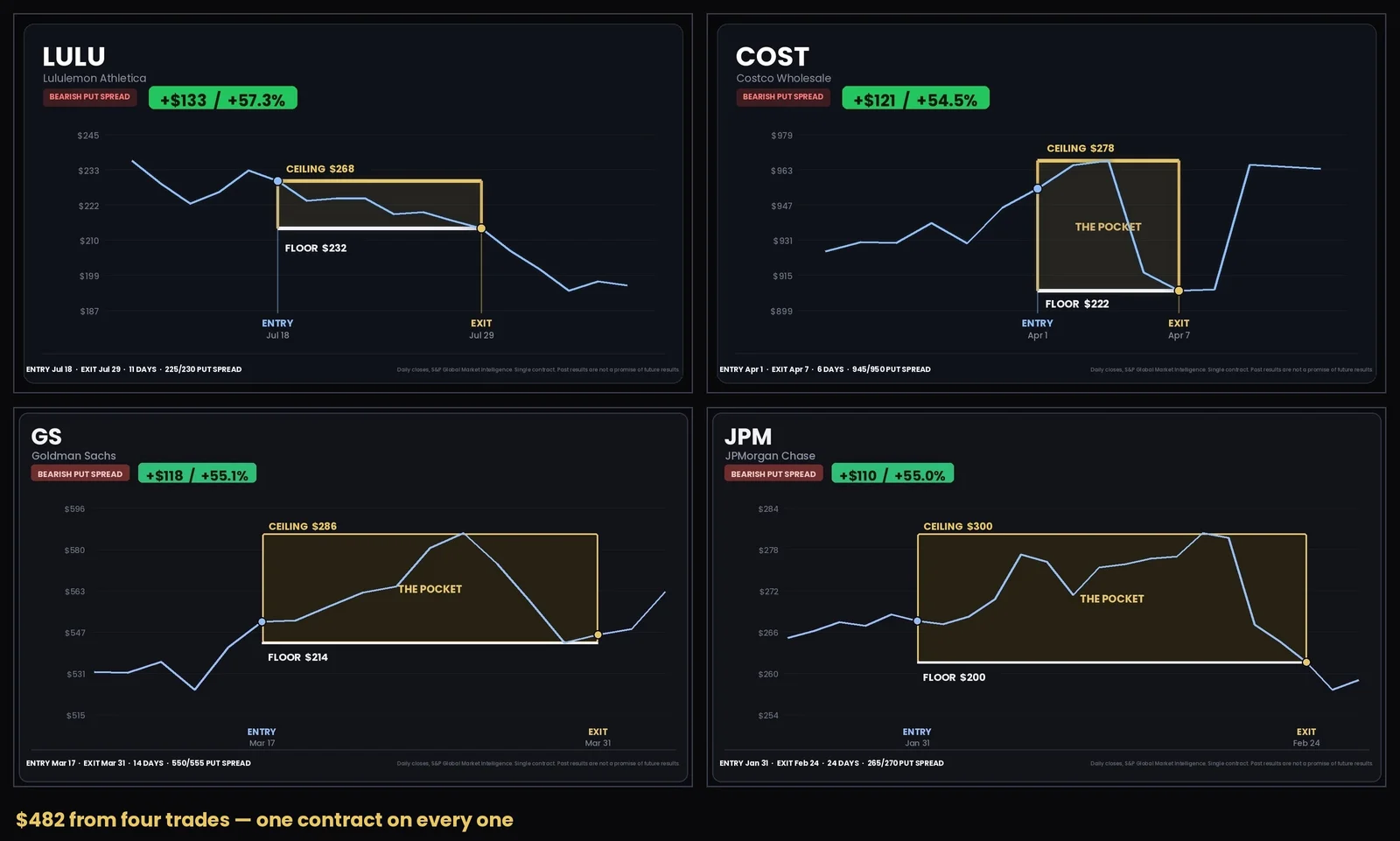
Then I put the whole record on the screen. Sixteen months of it. Every trade, winners and losers together.
January 3, 2025 through May 22, 2026. 59 winners, 18 losses, 3 break-even. Every figure on one contract — the smallest size there is. Past performance is not a guarantee of future results.
59 of those 80 worked. Almost three out of every four.
48 of the 59 winners came in at 30% or better. The smallest winner in there was just under 24%.
Across all eighty trades, on one single contract, that came to about $962.
And here’s the ugly part, from me, before you hear it anywhere else.
When I win, I average about $50. When I lose, I average about $111. My losers are more than twice the size of my winners.
I win roughly three times as often as I lose. Three small wins clear one bigger loss and leave money on the table.
The worst single loss in the sixteen months was $300. That was the whole trade, gone, and the account barely noticed.
Eighteen losses. Eighteen times the floor held exactly where I set it.
You’ve Been Taught to Guess.
Every options book opens the same way. Think it’s going up, buy a call. Think it’s going down, buy a put.
That’s a guess with no floor under it and a clock running against you. It’s also why people call options gambling, and in that form, they’re right.
Then you get taught the second thing. Set a stop-loss and you’re protected.
Here’s what a stop-loss actually does. Eight times out of ten the little dip knocks you out first, and then the stock turns around and goes exactly where you thought it would. You were right. You just weren’t there anymore.
And the third thing, the one that costs the most: that you have to guess which way the market is going.
Guessing direction is the hardest game there is. Nobody knows what Iran does next. Nobody knows what the Fed says on a Wednesday afternoon. Half of Wall Street says the AI trade pops this year and the other half says we’re fine.
A University of Florida study put a number on where that leaves people. The average retail options trader loses $16 of every $100 they risk.
University of Florida, Warrington College of Business. Independent academic research — separate from the TheoTrade trade record shown above.
I watched that happen from the inside for fifteen years. Chief Derivatives Instructor at thinkorswim, then running trader education at TD Ameritrade for seven million-plus people.
Smart people, doing exactly what they were told, getting wiped out anyway. The playbook is the problem. It was never you.
You set the floor before you click. The trade cannot fall through it.
Why This Market. Why Right Now.
Let me ask you something about your own money. For most people, retirement is one bet. Stocks go up. That’s the whole plan.
And right now a big piece of that bet is riding on ten AI companies. Half of Wall Street says that trade pops before the year’s out. The other half says we’re fine. Bill Ackman says this looks like the year 2000 all over again — everybody piling into chips and semiconductors while the quality gets left behind.
Bill Ackman, Pershing Square Capital Management — All-In podcast, June 3, 2026.
Nobody knows which. And if it breaks, you find out the same morning everybody else does.
Here’s what I know before I place a single trade. My floor, set by me, to the penny. My ceiling. The most I can lose and the most I can make, and neither number moves after that.
Up or down, there’s a Pocket in it. So I never have to call the top.
About one trade a week. Fifty or so a year. Every one with the worst case settled in advance. That’s how money grows steadily over years — and a jumpy market hands me more of these, not fewer.
There’s always another crisis coming, and these setups keep showing up right through it. So I’m not covering you for six months. You lock it in once today, and the trades keep coming for life.
The Four Parts of a Pocket.
Everything I showed you today comes down to four things. Not twenty-seven indicators. Four things.
Late June, here’s what everybody else was chasing. An AI chip name had run up more than 850%. A month later it had lost more than half its value. Cut in half.
That’s what chasing gets you. I don’t chase.
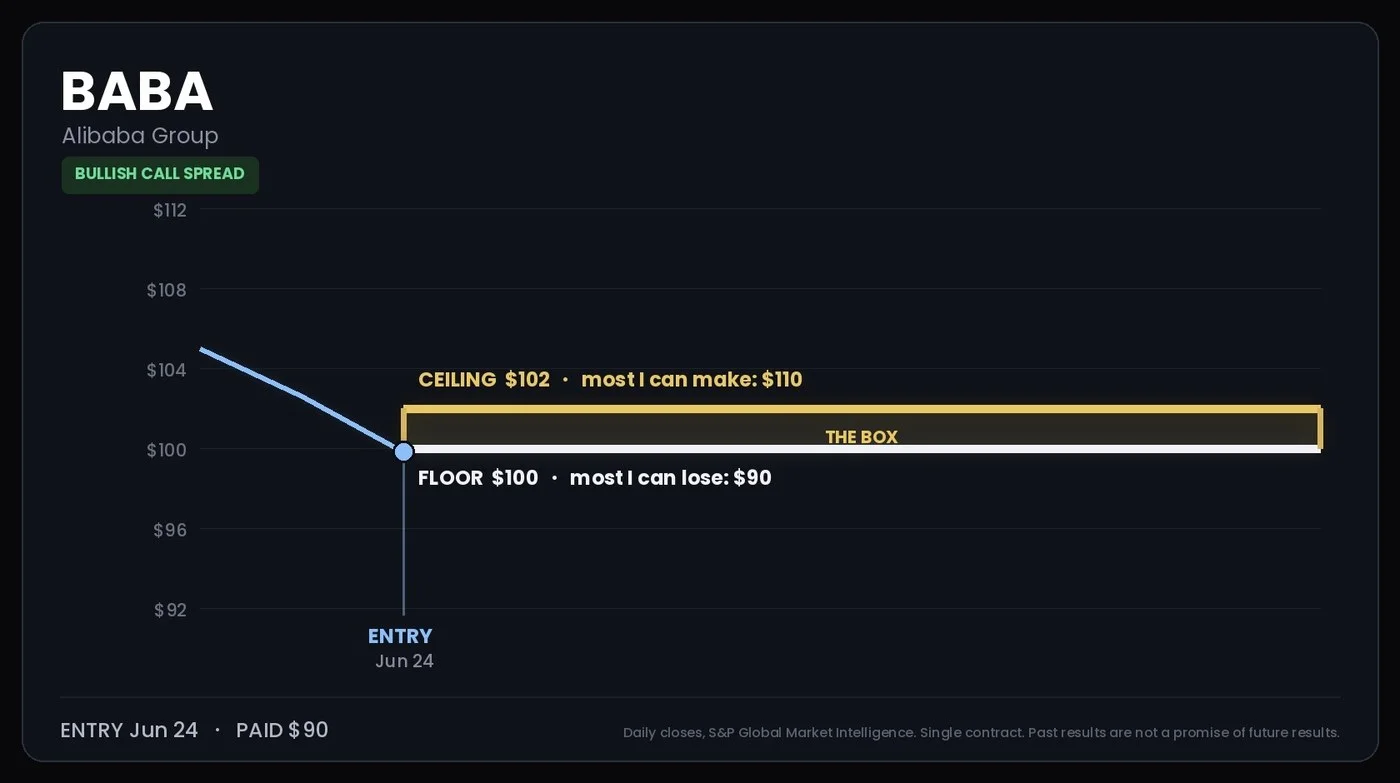
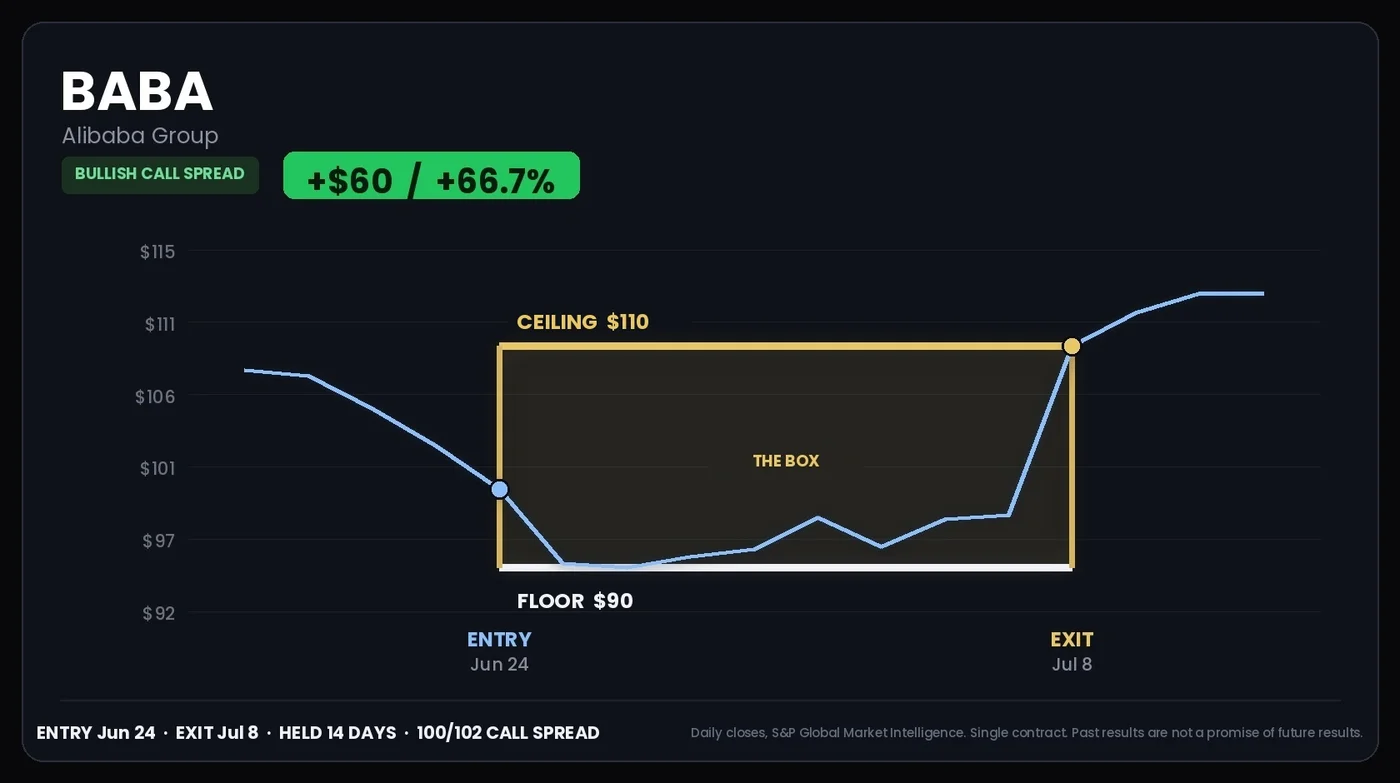
Same week, I was looking at Alibaba. About as boring as it got — nobody on television was talking about it. My signal fired, so I built the trade. Here’s how, in four moves.
Part 1
The Signal
One number, and it’s there every single week.
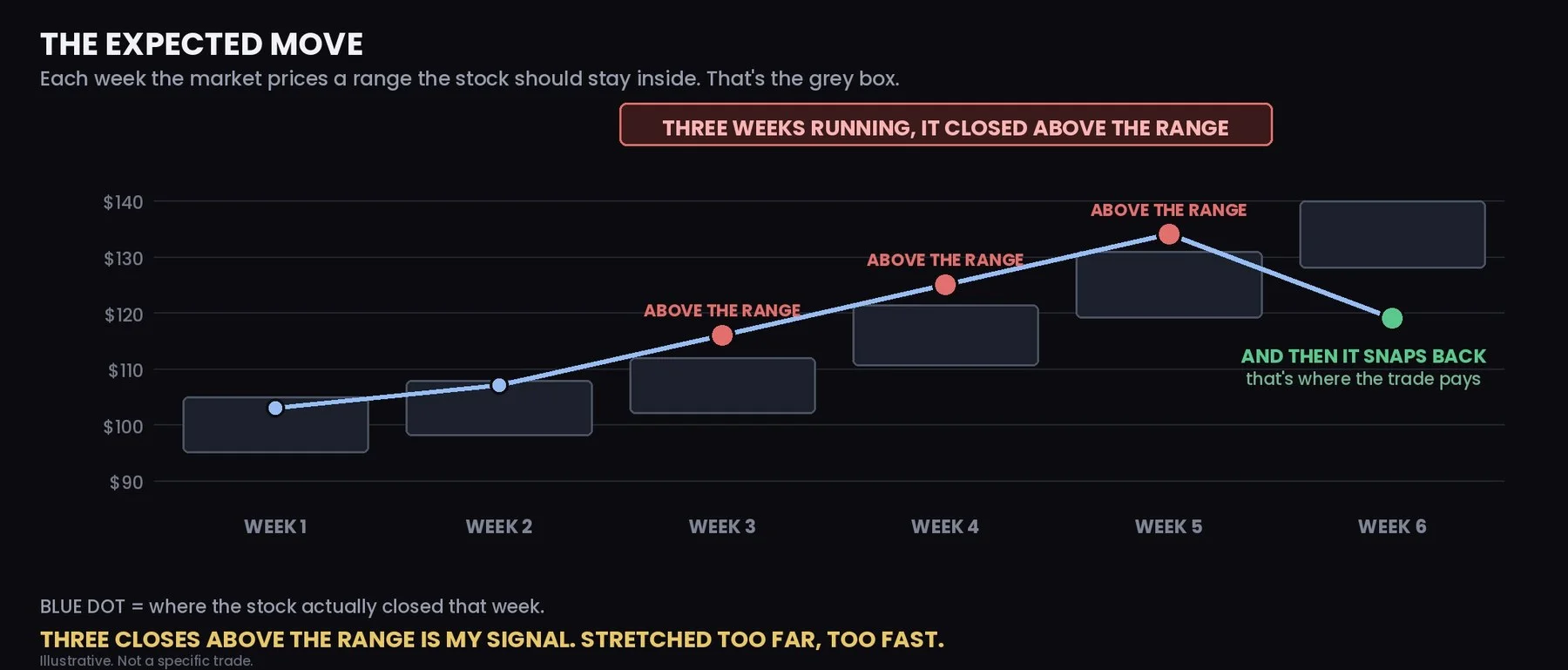
The options market prices in how far a stock should travel that week. That number is the expected move. It isn’t a forecast and it isn’t an opinion — it’s math, and it’s published every week whether anybody looks at it or not.
That’s the grey box on the chart above. Each week the stock is supposed to stay inside it. The blue dot is where it actually closed.
When a stock runs past it three weeks running, that stock is stretched. Too far, too fast. That’s the whole signal.
It either fires or it doesn’t. No signal, no trade. I’ve never found anything more reliable in twenty-five years.
Part 2
The Floor
The most you can lose, set by you, to the penny.
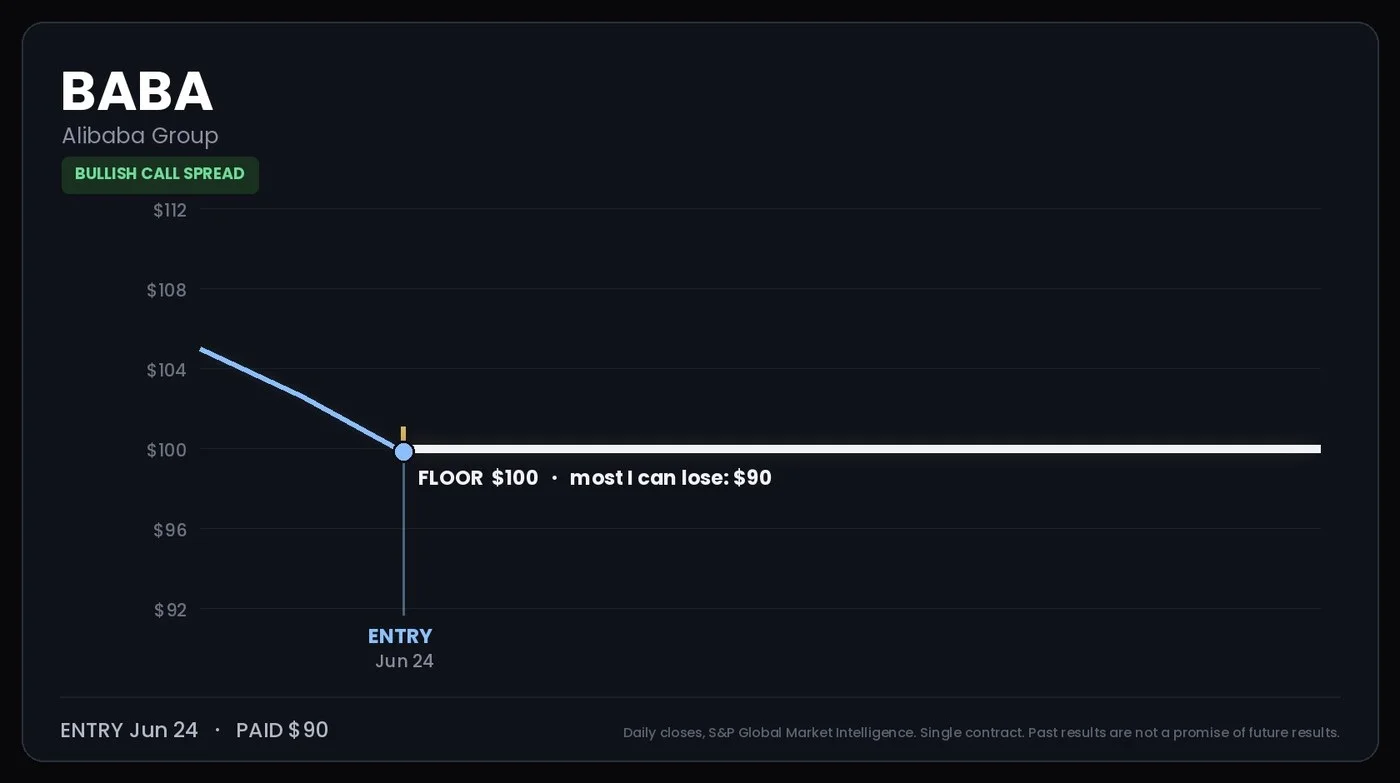
Whatever you pay for the spread is the most you can lose. On Alibaba I paid $90, so my floor was $90. That’s the entire calculation.
The market falls apart, the news goes against you, you’re flat wrong — you lose what you put in. Not a dollar more.
Eighteen losses across sixteen months. The floor held on all eighteen.
Part 3
The Ceiling
The most you can make, known going in.
Take the gap between your two price levels, subtract what you paid, and there’s your ceiling. Known before you risk a dime. On Alibaba that was $110.
I set mine in the same place every time: 30% or better on what I put up, inside 30 days or less.
You give up the moonshot. That’s the trade-off, and I’ll make it every time.
Part 4
The Hold
About a minute of work, then you go live your life.
Place it and walk away. Nothing to babysit. No stop to manage. No refreshing the account at red lights.
About one trade a week. Fifty or so in a year, each one going after the same number.
Two in the morning, there’s nothing to find out. Your worst case was settled before you clicked.
The Number Nobody Puts In Front Of You.
And why almost nobody trading from home is doing this.
Most trading services hand you a list. Ten picks, twenty picks, a chatroom full of tickers. You spread your money across all of them and hope the arithmetic works out.
This is one signal, one setup, and a floor you set yourself.
The reason almost nobody does it: that expected move number isn’t printed anywhere. You pull it out of the option chain, one name at a time, every week. It took me fifteen years to get fast at it.
I can’t hand you fifteen years. What I can do is hand you the finished trade.
And I show every number on one contract. The smallest size there is. Nobody can accuse me of dressing it up.
The trades you saw today risked between $90 and $230 each. What size you trade after that is your call. Most folks start at one contract and grow into it when they’re ready.
Picture Next Tuesday.
Mid-morning. Your phone buzzes.
It’s a Pocket alert. The company, exactly what to buy, what to pay, your floor, your ceiling, roughly how long to hold it. Spelled out.
New Pocket alert
CompanyAlibaba (BABA)
BuyThe 100/102 call spread
Pay$0.90 or less
Floor$90
Ceiling$110
HoldAbout two weeks
Illustrative example of the alert format.
You open your brokerage app. You copy what I sent. You paste it in. You’re done.
Under a minute. Then you close the laptop.
And here’s the part that takes people a while to get used to — you just leave.
Lunch. The dog. The grandkids. Whatever it is for you.
You’re not glued to a screen. You’re not checking your phone every fifteen minutes at every red light. Your worst case is already settled, so there’s nothing to check.
Fourteen days later it closes out and the next one comes.
Same market. Same account. Different life.
Real Members. Real Results.
Unsolicited. Nobody asked them to say this.
“The Pocket trades have been excellent. Mostly winners of 30-55%.”
— Kartik B., Missouri
Individual results vary and are not typical. Trading involves risk of loss.
“I set up a tiny $2,500 account to test the Pocket trades. Risk was $150-$250 per trade. 17 wins, 3 losses. My original $2,500 is now just over $4,000. Thanks Don!”
— Paul P., Georgia
Individual results vary and are not typical. Trading involves risk of loss.
“Started a small account trading 1 lot Pocket trades. Once I was comfortable and winning, I moved up to 3 lots and doubled. Now I’m close to doubling again and moving to 5 lots.”
— Kent A., Indiana
Individual results vary and are not typical. Trading involves risk of loss.
Here’s Everything Inside Lifetime Pocket Profits Alerts.
Total retail value: $13,241
Six components. Let me walk you through every one.

Lifetime Pocket Profits Alerts
Retail value: $9,950
Every Pocket trade I take goes to you the second I place it. The company, exactly what to buy, what to pay, your floor, your ceiling, roughly how long to hold.
About one a week. Every one of them aiming at the same number — 30% or better, in 30 days or less. You don’t have to work out what to aim at. It’s already set.
Not for six months. Not for a year. Year two, year five, year ten, the trades keep coming and you don’t pay another dime.
These aren’t hair-trigger trades either. You’ve generally got the day to get in. Miss one entirely and there’s another one next week.

The New Live Pocket Masterclass
Live: Thursday, September 10 at 11:00 AM Eastern
Retail value: $297
I’m teaching this one live myself, and it’s the deepest I’ve ever gone on this method.
The expected move — what it is, how to work it out, and how to spot a stock that’s run past it three weeks running. In other words, how to find these yourself.
You’ll still get every trade I take. You’ll just know how I found it.
It sells for $297 on its own. Can’t make it live? It’s recorded and it’s yours to keep.
The Pocket Tracker
Retail value: $500
Every position I’m in, live, exactly the way I see it. Up to the minute, as it happens.
So you’re never in the dark about what I’m actually holding. You see it, you follow along, and you know you’re getting the real thing.
Every trade I’ve already closed is in there too. The whole record, floor and ceiling on each one. Check the results any day of the week you like.
Pocket Live Sessions
Retail value: $997
This is the one members tell me they value most. I pull up the real names setting up right now and build the Pockets in front of you.
Bring your questions. Not sure when to get in, when to get out, want a second set of eyes before you click — you ask me, right there, live.
As time goes on you get sharper. You start spotting the setups yourself.

Pocket Direct
Retail value: $1,000
Email access to me personally. You hit a wall on a setup, or you’ve got a question only I can answer — you write me.
A real person on my team, or me, writes back. Not a bot. Not a ticket number. A human who trades this every single day.
Most places hide their guy behind a support form you’ll never get through. For as long as you’re in, I’m reachable.

The Pocket Concierge
Todd Sweet — former CBOE floor trader
Retail value: $497
Todd is my right-hand man and your Concierge Options Specialist. He traded these for a living on the floor of the Chicago Board Options Exchange.
One-on-one, whenever you need him. Should I take this one? How do I place it? What size? Do I close it or hold? Whatever it is, you ask Todd.
Most folks never need him. He’s there the day you do.
Here’s the catch, and it’s a real one. Todd is one man, so this goes to the first 50 people. Fifty-one onward, it comes off the table.
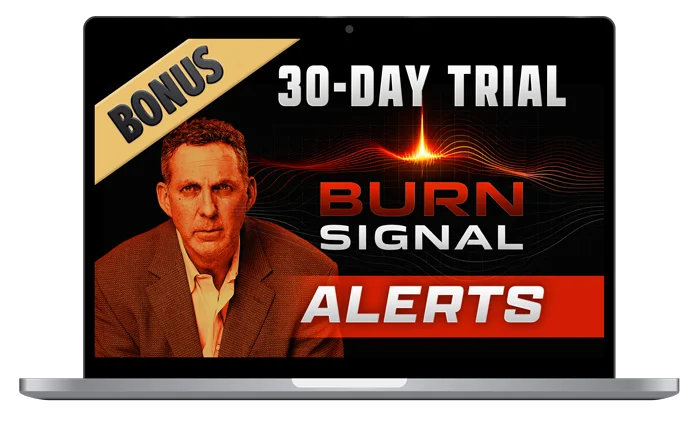
Bonus — included today
30 Days Inside Burn Signal
Professor Jeff Bierman — Chief Market Technician
Retail value: $166
There’s a whole side of this market I don’t touch. I work the names everybody’s watching — the big ones, already stretched past what the market expected. Jeff works the quiet ones nobody’s talking about, right up until they move.
Jeff and I sat side by side at TD Ameritrade for eight years. He was their head chart man, I ran trader education. 38 years in the markets, a decade running his own hedge fund, and he teaches graduate finance at Loyola and DePaul.
You get roughly two alerts a week — his own trades, the same as he takes them. Plus the Burn Signal Masterclass, a live session with him every month, and his model portfolio.
Burn Signal is rarely open to the public. He’s opening a space specifically for the people who join me today. At the end of the 30 days we ask if you want to keep it. That’s it.
So Add It All Up.
Two Ways In. Pick One.
Ask yourself what a lifetime of these fairly ought to be worth.
One trade a week, handed to you, for as long as you trade. Put a thousand a year on that and nobody would call it unfair. Ten years of it comes to $9,950. And ten years isn’t long — plenty of you have been at this longer than that already.
Here’s what I decided instead. I’m charging you one year. One year’s money, one time.
The same figure other services charge you every twelve months. Except you pay it once, and then you’re done with me forever. No renewals. No re-upping. No anniversary invoice landing in your inbox next August.
Total retail value: $13,241
Your price today
$995
One time · No renewals · Ever
Or two payments of $549. Paying in full today saves you $103.
Grab a napkin, because I want you to actually see what “for life” means.
About one Pocket trade a week. Over ten years that’s around 520 trades.
$995 across ten years is $99.50 a year. That’s $8.29 a month, or about $1.91 a trade. Trade longer than ten years and it only gets smaller.
And here’s the other side of that arithmetic. Run the University of Florida figure on a $10,000 account traded the ordinary way and you’re looking at roughly $1,600 gone in a year. Every year.
So the question isn’t whether you can afford to fix this. It’s whether you can afford another year of not fixing it.
Two Guarantees. Both Ironclad.
You don’t have to decide today whether this is right. Just take it for a test drive.
Guarantee #1

The 30-Day Money Back Guarantee.
Get in today. Watch the alerts as they land. Place one if you want to, or place none at all and just watch.
If at any point in the next thirty days you decide it isn’t for you, email my team and every dollar comes back. No strings. No forms. No argument.
Guarantee #2
The Extended 90-Day, 10-Trade Guarantee.
And I’ll go one further. Give the strategy a fair test — take ten qualifying Pocket trades inside your first 90 days.
If after those ten you’re still not satisfied, send us your trade record and we’ll refund every dollar you paid.
Two ways out. The risk of finding out sits with me, not you.
The Concierge Goes to 50 People.
Todd is one man. He traded on the floor of the Chicago options exchange, and he answers members one-on-one himself.
Fifty is the number where he can still give every person the attention they’re paying for. Past fifty, the queue gets long and I can’t do what I promised.
Once the first 50 seats are taken, the Concierge comes off the table. The alerts stay. Todd doesn’t.
Enrollment closes September 10th.
The Masterclass runs live that morning at 11:00 AM Eastern, and I’m not teaching it twice.
The signal fires whether you’re on the list or not. About one a week, every week the market’s open.
The people who joined get the trade in their hand. Everybody else opens their platform and wonders what to do.
The Questions I Know You’re Asking.
“I haven’t got time for this.”
Good — neither have I. This isn’t day trading. One move a week, and it comes to you. Place it, close the laptop, live your life. If you’ve got a spare minute mid-morning, you’ve got time for this.
“I’ve never traded an option in my life.”
That’s an advantage. No bad habits to unlearn, and nobody’s taught you the wrong way yet.
The trade arrives spelled out. The company, what to buy, what to pay, your floor, your ceiling. You’re never staring at a blank screen wondering where to start.
“I haven’t got an options account.”
No problem. Todd walks you through it. Fifteen years inside the brokerage business for me, and Todd traded on the floor of the Chicago options exchange. Most folks are approved inside a day or two.
“Can I do this in my IRA?”
Plenty of brokers allow these — the kind where your loss is capped up front. It comes down to your broker and your approval level. Ask us and we’ll help you sort it out.
“You say lifetime. What if you stop?”
Fair thing to ask about anything called lifetime, so let me answer it straight.
I started TheoTrade in 2015. That’s coming up on twelve years and I’m not going anywhere. It’s what I do.
And think about it — if I were planning on winding down, handing you something with no renewal on it would be a strange way to go about it.
“How much do I need to start?”
Enough to place one of these without it keeping you up at night. The trades you saw today risked between $90 and $230 each.
Every number I showed you was one contract, the smallest size there is. Most folks start at one and grow into it when they’re ready.
“What if I miss an alert?”
You’ve generally got the day to get in. Miss one entirely and there’s another one next week. Nothing about this runs on a hair trigger.
“How do I know these results aren’t cherry-picked?”
Because I showed you the losers. All eighteen of them, the average loss, and the worst one. Anybody can show you their five best trades.
Sixteen months, eighty trades, one contract on every one. The whole record sits in the Tracker and you can check it any day of the week.
This Is Bigger Than One Trade.
The world is getting harder. You feel it. Everybody feels it.
Inflation isn’t a headline — it’s your grocery bill. It’s the look on your face when you check your account at the end of the month and wonder where it all went.
And your money is sat right in the middle of a market nobody can call. If it drops, you lose. If you pull out and it keeps climbing, you miss it.
So here’s what I actually want you to take from today.
A retirement that doesn’t live or die on whether ten AI companies keep going up.
Fifty quiet trades a year, each one with the worst case settled before you click. Not because you got lucky once. Because you did the same boring thing fifty times.
Remember why I walked away from the brokerage business in 2015. The red tape in there stopped me putting the trades I actually use into regular people’s hands.
This is that. This is me handing them to you. Today, and for life.
In The Pocket. Or Out Of It.
There are two ways to trade this market. Most people are on the wrong side of it through no fault of their own — it’s just what they were taught.
Out of The Pocket
Guesses the direction, then hopes.
Finds out the worst case after it happens.
Sets a stop, gets knocked out, watches it turn around without them.
Phone out at every red light. Again in the parking lot.
Dinner’s on the table and they’re still thinking about the close.
Two in the morning, reaching for the phone before the light switch.
Twelve months from now, still watching. Still waiting for things to calm down.
In The Pocket
Waits for one signal to fire.
Sets the floor and the ceiling before clicking buy.
Nothing to stop out of. The floor is already set.
About a minute to place it, then the laptop closes.
Coffee’s still hot when they’re done.
Sleeps through the night. Nothing to find out.
Twelve months from now, about fifty of these placed. One a week.
Same you. Same account. Same market.
And here’s the part nobody tells you. When you close this page, you will have picked one. Doing nothing is picking one.
In The Pocket. Or out of it.
Which one are you the next time that signal fires?
The choice I’m asking you to make today isn’t really about $995. It’s about which side of that line you trade on.
Because one way or the other, next week happens. A stock runs three weeks past its expected move. I build the Pocket and the alert goes out.
You’ve been out of The Pocket your whole trading life. Today’s the day you can step alongside me.
Ready to Join Me?
Scroll down and fill out the form. Takes about 90 seconds.
- Option 1 — $995 one time. No renewals, ever. Saves you $103. (most popular)
- Option 2 — Two payments of $549. Second payment 30 days later.
- Lifetime Pocket Profits Alerts — every in-out spread I take, about one a week, for life
- The New Live Pocket Masterclass — live September 10 at 11:00 AM ET, recorded and yours to keep ($297)
- The Pocket Tracker — every open position and every closed trade, live ($500)
- Pocket Live Sessions — I build Pockets on camera and answer your questions ($997)
- Pocket Direct — email access straight to me ($1,000)
- The Pocket Concierge — Todd Sweet, one-on-one. First 50 people only ($497)
- Bonus: 30 days inside Burn Signal with Professor Jeff Bierman. No auto-renewal ($166)
- Two guarantees — 30 days money back, or 10 trades inside 90 days
- Enrollment closes September 10th
Prefer to enroll by phone, or use account credits? Call us on 623-244-5657.
The Signal Doesn’t Wait.
It fires when it fires. About one a week, whether you’re on the list or not.
The alert goes out. The floor and the ceiling are already set. The people who joined place it in about a minute and get on with their day.
You saw the trades. You saw the record. You saw the floor hold eighteen times out of eighteen. You know what this is.
A stock is going to run past its expected move next week whether you’re ready or not.
The only question is whose hands the trade lands in.
Fill out the form below. I’ll see you on the inside.